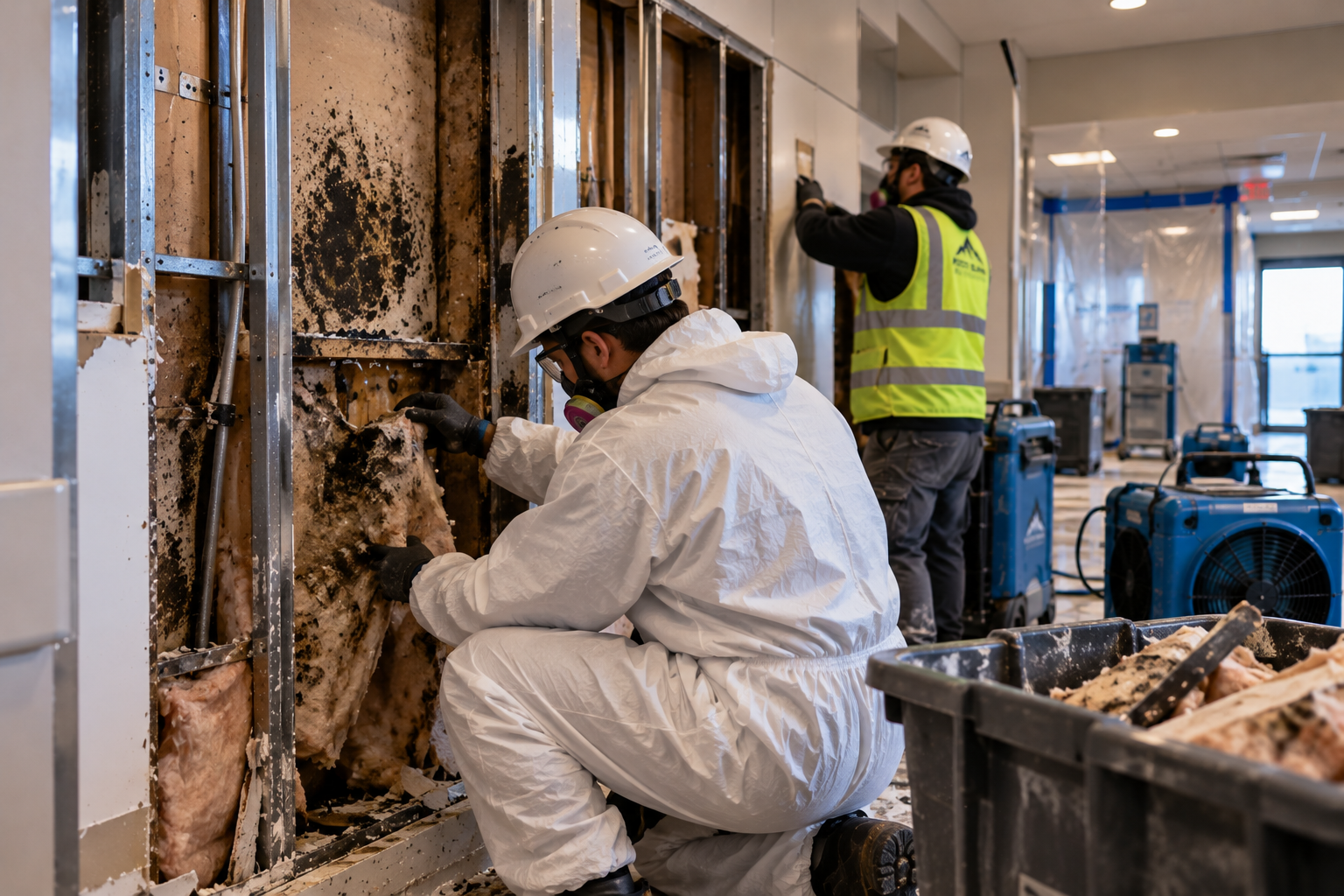
Follow moisture rather than color
Mold can develop when susceptible materials remain damp. Plumbing leaks, roof failures, condensation, and repeated wetting can create concealed conditions even when occupied rooms look normal. Color cannot reliably identify species or determine health risk. Persistent odors, recurring stains, or elevated material readings warrant investigation, but none of these observations alone proves the extent of mold contamination. Document the moisture history before deciding how to open assemblies.
Investigate building assemblies systematically
Water can migrate behind drywall, into insulation, above suspended ceilings, under flooring, and along utility penetrations. Inspect both the apparent source and connected assemblies. Thermal imaging helps identify temperature differences that may warrant further investigation; it is not a mold detector and does not replace direct moisture measurements. Controlled openings should be planned with occupant protection, utilities, and potentially hazardous building materials in mind.
Containment protects adjacent operations
Work-zone separation is based on the extent of contamination, removal activities, building layout, and occupant sensitivity. Barriers, protected access, and negative-pressure strategies can help limit migration of dust and particles. HEPA-filtered air equipment supports particle control but does not correct the leak or remove contaminated material by itself. Pressure relationships need monitoring, especially near HVAC returns, doors, and occupied sensitive spaces.
Remove and clean with an appropriate scope
Some porous materials may require removal because contamination cannot be adequately cleaned. Other surfaces may be cleaned using methods suited to the material and scope. Uncontrolled demolition, dry brushing, and ordinary vacuuming can disperse particles. Antimicrobial products are not a substitute for physical removal, effective cleaning, and moisture correction. Before disturbing older assemblies, evaluate whether separate asbestos or lead requirements apply.
Consider health and HVAC concerns carefully
Damp indoor environments can affect sensitive occupants, including people with allergies, asthma, or impaired immunity. A restoration contractor should not diagnose symptoms or make unsupported claims about toxicity. Consult healthcare professionals for medical concerns. If HVAC components may be involved, coordinate assessment and isolation with qualified HVAC and environmental professionals instead of assuming ordinary duct cleaning solves the problem.
Define verification before starting work
Post-remediation verification may include visual assessment, confirmation of moisture correction, and evaluation against project-specific criteria. Independent environmental assessment or sampling may be appropriate depending on the building, occupants, scope, and contract. There is no universal air-sampling number that certifies every building safe. Keep written findings and clearance requirements separate from routine daily drying logs.
Prevent the next moisture event
Repair the source, improve drainage and ventilation where appropriate, maintain roofs and plumbing, and trend indoor humidity. Establish reporting procedures for tenant leaks and odors. Do not close walls or reinstall finishes over unresolved dampness. Review policy-specific mold limits and notify the insurer promptly when a covered water event may be involved. Scope, photos, material readings, disposal records, and verification documentation make the recovery easier to review.

